What Was Martha So Upset About?

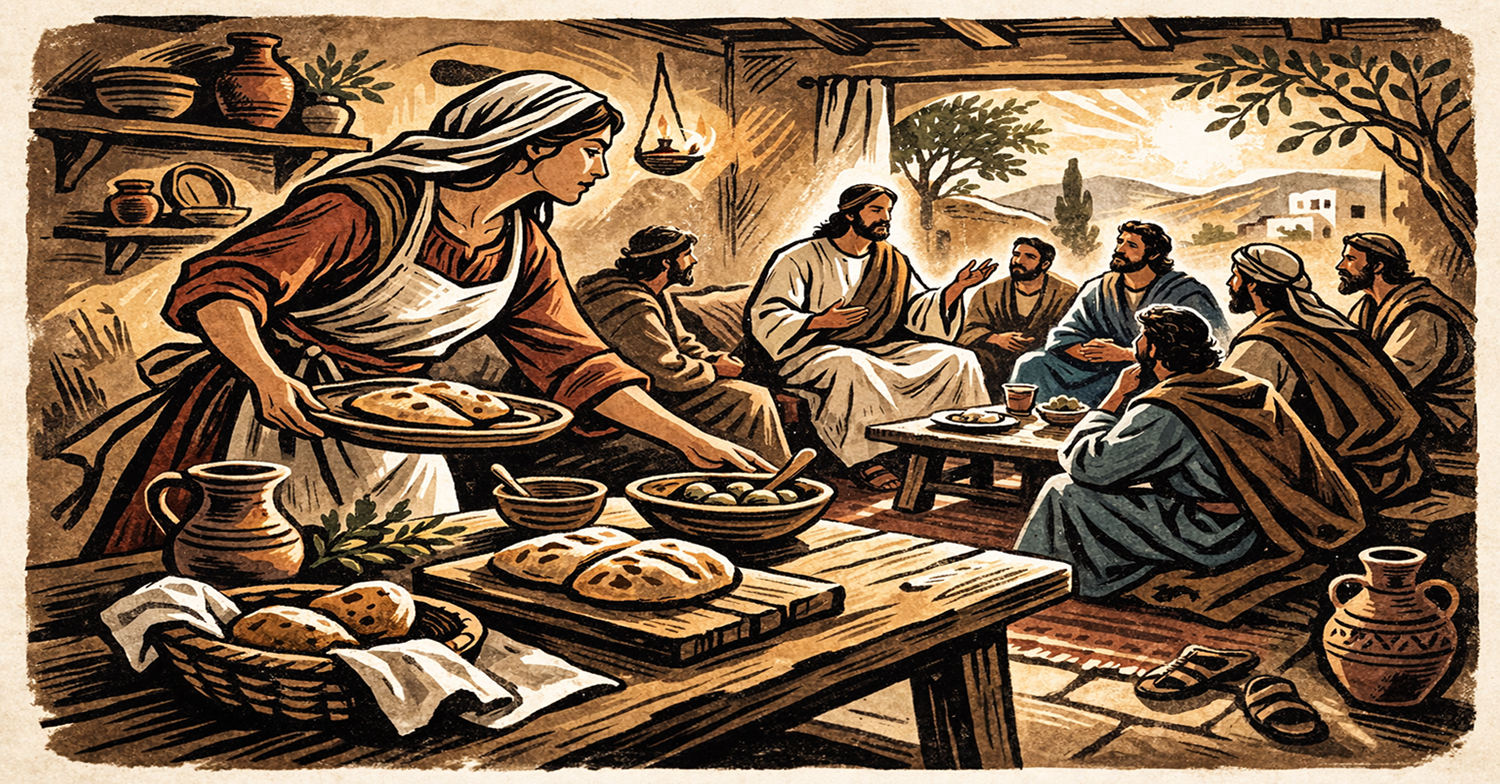
Martha must have been really excited for Jesus to arrive. Luke 10:38 says she welcomed Jesus into her home. This has led some scholars to believe that Martha was the oldest and she managed the household. It’s no wonder she was busy trying to serve food and make Jesus and his friends comfortable. How would you like to entertain at least 13 people in your living room on short notice? Martha responds by going to work, and later seems to be rebuked for it. But what if this story isn’t about work versus worship at all, but about anxiety, honor, and who is allowed to sit at Jesus’ feet?
In the ancient world that this story comes from women were under tremendous social pressure to present a well-ordered home. When a visitor came to your home, the level of hospitality you showed was tied to your family’s honor. Martha would remember that her ancestor Abraham had begged strangers to stay and eat in Genesis 18. She would recall that he quickly told Sarah to prepare cakes for the men to eat while he washed their feet as they rested. She would recall that Abraham’s nephew Lot provided shelter and protection for these same men when they visited Sodom in chapter 19. The words of Job might even come to her mind when he said, “No stranger had to spend the night in the street, for my door was always open to the traveler” (Job 31:32, NIV). Proverbs 31 is dedicated to the virtues of a woman who keeps her household in perfect order, bringing honor to her family. And as if that wasn’t enough, the wider Greco-Roman world taught that how well a woman ordered her house was foundational to the social structure and economy of the entire country.
Bethany was a small town with only a few dozen homes at the time of Jesus. Even so, of those few dozen, Jesus had stopped at Martha’s home. So, it only seems natural that Martha was deeply burdened by the honor of both her family and her village as she worked to make sure this important teacher and his guests were comfortable and well fed. And so she toiled away in the kitchen cooking, cleaning, preparing, and serving. She did all of this because of the longstanding traditions of God’s chosen people and to honor her special guest.
But her sister didn’t seem to care. Luke tells us that while Martha was busy with all of her work, Mary simply sat at Jesus’ feet and marveled at his teaching. If you are familiar with this story, you know what comes next. Martha is frustrated with her sister and asks Jesus to intervene by telling Mary to get to work. Instead, Jesus refuses and rebukes Martha, telling her she should be more like Mary, who has chosen what is best.
But Martha was distracted by all the preparations that had to be made. She came to him and asked, “Lord, don’t you care that my sister has left me to do the work by myself? Tell her to help me!” “Martha, Martha,” the Lord answered, “you are worried and upset about many things, but few things are needed—or indeed only one. Mary has chosen what is better, and it will not be taken away from her.” Luke 10:40-42
At least that is how I remember hearing it taught. The point of the story seemed to be that work and preparation were somehow bad things. That type-A personalities would be rebuked by Jesus, like Martha was. That we should be Marys in a Martha world. And to be honest… that really makes me mad. Because that teaching seems to say that all the worker bees in the church who are slaving away serving for the sake of those who just show up, are less spiritual than the people who walk in at the last minute, without a dish to pass, jumping right into the front of the potluck line. I don’t think this is what Jesus meant.
The text in Luke 10 supports the idea that there is more going on here. Jesus says a few things are needed- or indeed only one. This sounds like Jesus is dismissing the many needs of cooking and serving as unimportant to favor sitting at his feet. Some scholars have pointed out that the Greek of the second phrase is not oppositional to the things that are needed, as it reads in English, but rather is trying to convey that many things are necessary, but only one of them is truly needed at the moment. In this reading, Jesus acknowledges that Martha’s work is good and valuable, but at the moment, it is creating anxiety in her that is distracting her from his presence and threatening to do the same for Mary.
But this might even go a step further. It is not too large a leap to imagine that Martha was embarrassed by Mary’s behavior. Perhaps, specifically, she was embarrassed that Mary was breaking a gender taboo by sitting at Jesus' feet with the boys. Sitting at the feet of Jesus is often used as a euphemism for being a disciple. Every time we see Mary in the Gospels, she is at Jesus' feet. Several scholars have suggested that Luke purposely uses this phrase to show the high value Jesus had for women, even to the point of them being his disciples. Could it be that Martha is horrified that her sister would presume she, as a woman, could sit at the feet of this important RabbI? We don’t know exactly how the first-century crowd would have viewed this. Women were active in the synagogue and could be taught Torah there. But the Talmud records passages like this from a rabbi born less than 20 years after Jesus' death.
“Rabbi Eliezer ben Hyrcanus says: Whoever teaches his daughter Torah teaches her obscenity.”
Sotah 21b
What if what is really going on here is that Martha is upset not because she needs help from her sister, but because she is worried about what everyone will think about her and her sister? Here she is working as hard as she can to bring honor to her family and her village as a good Jewish hostess should, and her sister ruins it all by presuming to be as important as the men, thus bringing shame on their family name. That would explain her becoming so angry that she is willing to interrupt her guest as he teaches to ask him to help push Mary back into her correct social role.
But Jesus responds with something like, Martha, you are worried about so many things. You are anxious about what people think about you. You are concerned about social norms, gender roles, and reputations. But I came here to undo all of that. I came here to shake things up. I came here to teach you a different way. So come, sit at my feet as well. You have done enough. You have been a wonderful host. Now, be present with me as I disciple you. Because I love you and value you just as much as the men.
Is that exactly what is happening here? We can’t be certain. But this reading fits both the text and the heart of Jesus we see in scripture. It is awfully hard to dig back through two thousand years of language, culture, and theology to come up with a definite answer to every question. But I think there is an honest way of understanding this text that helps us in the modern world to know that Jesus honors our work and our presence. That Jesus sees us in our service while simultaneously desiring us to sit at his feet, regardless of gender, race, or social class.